

In today’s fast-moving online world, slang terms pop up everywhere—from social media captions to casual chats. One such trending term is BTA Meaning, which often leaves people curious about what it actually stands for. Used to describe something that’s better than ordinary, this phrase adds a confident tone to conversations. Understanding the BTA Meaning helps you stay in sync with modern digital language.
When someone uses BTA Meaning in slang, they’re usually talking about quality, performance, or vibes that are above average. It’s simple, catchy, and widely used by younger audiences online. Knowing the BTA Meaning makes it easier to interpret comments and reactions correctly. Overall, the BTA Meaning reflects how slang keeps communication short, expressive, and relatable.
BTA Meaning & Definition
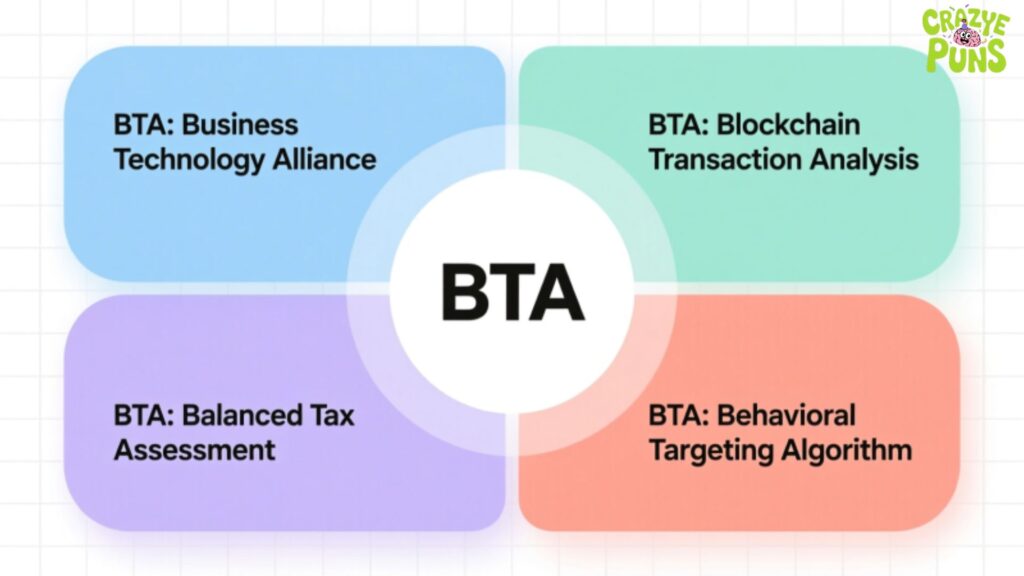
At its core, BTA meaning varies dramatically based on the setting in which it appears. The acronym’s flexibility makes it particularly interesting to linguistic observers and everyday communicators alike. In casual conversation, BTA most commonly stands for “But Then Again,” serving as a conversational pivot that introduces alternative perspectives or second thoughts. However, this same three-letter combination carries entirely different weight in business boardrooms, where it might reference “Business Technology Analyst” or bilateral trade agreements.
The beauty of BTA lies in its contextual nature. Unlike rigid acronyms with singular definitions, BTA adapts like a linguistic chameleon, shifting its meaning to suit the environment. This adaptability reflects broader trends in modern communication, where efficiency and context reign supreme. When someone types BTA in a text message, they’re participating in an unspoken agreement about shared understanding—a digital shorthand that assumes the recipient will intuitively grasp the intended meaning.
What Does BTA Mean in Slang?
In the realm of informal communication, the BTA meaning in slang predominantly translates to “But Then Again.” This usage emerged from the natural evolution of internet speak, where users constantly seek ways to compress complex thoughts into manageable chunks. When someone texts “I think we should go to the beach, BTA it might rain,” they’re efficiently introducing a counterpoint without lengthy explanation.
The slang version of BTA serves multiple conversational functions. It acts as a linguistic buffer, softening potentially contradictory statements and creating space for nuanced discussion. Rather than appearing argumentative or indecisive, using BTA signals thoughtful consideration of multiple angles. It’s the textual equivalent of that contemplative pause in speech when someone reconsiders their initial statement.
Young people, particularly Gen Z and younger millennials, have embraced this usage enthusiastically. The acronym appears frequently in casual texts, Instagram DMs, and TikTok comments, where brevity isn’t just preferred—it’s practically mandatory. This demographic’s comfort with layered meanings and contextual communication makes BTA a natural fit for their digital vocabulary.
Also Read This WYF Meaning Explained: Texting & Social Media Use
BTA Meaning in Business and Finance
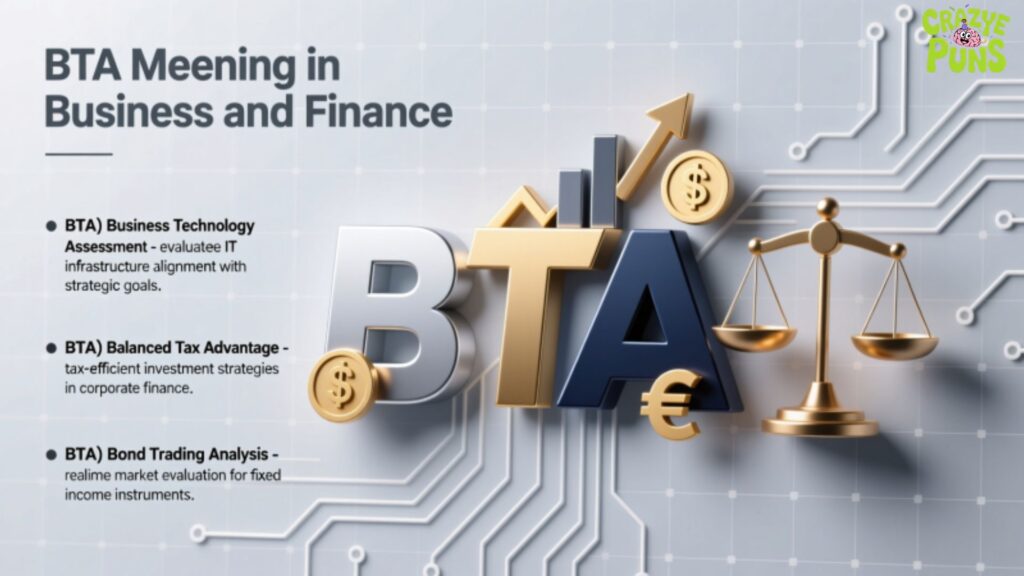
Step into a corporate environment, and the BTA meaning transforms entirely. In business contexts, BTA frequently represents “Business Technology Analyst,” a professional role focused on bridging the gap between technological capabilities and business needs. These analysts evaluate systems, recommend improvements, and ensure technology investments align with organizational goals.
Financial sectors know BTA as shorthand for “Bilateral Trade Agreement,” referring to commerce pacts between two nations designed to reduce tariffs, streamline regulations, and promote economic cooperation. When trade negotiators discuss BTA terms, they’re shaping international economic relationships that affect millions of consumers and businesses.
The business world also uses BTA for “Before Tax Adjustment,” an accounting term relevant during financial reporting and analysis. Understanding which BTA meaning applies requires industry knowledge and contextual awareness. A message reading “Review the BTA metrics before the quarterly meeting” means something entirely different in an accounting firm versus a tech startup versus an international trade office.
Origin and Evolution of BTA
Tracing the precise origins of BTA meaning reveals the fascinating ways language adapts to technological change. The “But Then Again” usage likely emerged in the early 2000s alongside the explosion of text messaging and instant messaging platforms. As character limits constrained communication and typing on phone keypads proved tedious, users innovated abbreviated expressions.
Internet forums and chat rooms served as linguistic laboratories where acronyms were tested, refined, and either adopted or discarded by the collective. BTA survived this evolutionary pressure because it filled a genuine communicative need—the ability to introduce contrary thoughts concisely. Unlike some acronyms that feel forced or overly niche, BTA’s phrasing mirrors natural speech patterns, making adoption intuitive.
The business and technical meanings of BTA developed along parallel but separate tracks, emerging from professional jargon rather than casual conversation. As industries standardized terminology, certain abbreviations became official designations. The coincidental overlap between casual and professional BTA usage creates occasional confusion but also demonstrates how the same letter combination can serve radically different communicative purposes.
BTA in Texting & Social Media
Modern social media platforms have become the primary incubators for evolving BTA meaning and usage. On Twitter, where character counts matter, BTA provides efficient expression. Instagram captions and comments employ the acronym to create conversational tone while maintaining brevity. TikTok comments, often rapid-fire reactions to video content, frequently feature BTA as users process and respond to what they’ve watched.
The visual nature of platforms like Snapchat and Instagram Stories has interesting implications for BTA usage. When text overlays images or appears alongside video content, every character carries weight. BTA allows creators to maintain punchy, readable text without sacrificing nuanced communication. A Story showing a rainy day might include text reading “Perfect reading weather, BTA Netflix sounds good too,” efficiently conveying multiple moods.
Social media algorithms favor engagement, and BTA contributes to this by encouraging response. When someone posts “This restaurant looks amazing, BTA it’s pretty expensive,” they’re inviting dialogue about priorities, budgets, and whether the experience justifies the cost. The acronym becomes a conversational catalyst rather than a conversation-ender.
BTA Meaning in Text Messages and Chats
Private messaging contexts showcase the BTA meaning most naturally. In one-on-one texting conversations, BTA serves as a thinking-out-loud marker, letting the recipient observe the sender’s thought process. This transparency builds intimacy and understanding, transforming what could be contradictory statements into collaborative thinking.
Group chats present particularly fertile ground for BTA deployment. When multiple people discuss plans, BTA helps individuals contribute ideas while acknowledging complexity. Someone might text the group: “Let’s meet at 7pm, BTA some people work late so maybe 8pm is safer.” This usage demonstrates consideration for others while keeping conversation flowing efficiently.
The beauty of BTA in messaging lies in its tone. Unlike blunt contradiction, BTA softens potential disagreement. It transforms “Actually, that’s wrong” into “That’s one perspective, BTA here’s another angle.” This diplomatic quality makes BTA valuable for maintaining positive relationships while engaging in genuine discussion.
Usage of BTA in Daily Conversations

While BTA originated online, its BTA meaning has occasionally crossed into spoken conversation, particularly among digitally native generations. Someone might actually say “bee-tee-ay” aloud during casual discussions, though this remains less common than textual usage. More often, the thinking pattern BTA represents influences how people structure verbal arguments, even when they don’t vocalize the acronym itself.
Daily usage reveals patterns in how people employ BTA strategically. It frequently appears when discussing plans, expressing preferences, or evaluating options. The acronym helps speakers present balanced viewpoints without seeming wishy-washy. “I’m excited about the concert, BTA if I’m too tired we can skip it” communicates enthusiasm while setting realistic expectations.
Understanding BTA meaning in context requires reading conversational cues. The same message can carry different emotional weight depending on relationship dynamics and prior discussion. Between close friends, BTA might signal genuine uncertainty. In professional contexts, it might indicate diplomatic disagreement. This contextual flexibility makes BTA simultaneously powerful and potentially ambiguous.
BTA vs. Similar Slang
Comparing BTA to similar acronyms illuminates what makes each abbreviation unique. “OTOH” (On The Other Hand) serves comparable functions but sounds more formal and deliberate. OTOH typically introduces substantial counterarguments, while BTA feels lighter, almost conversational. The BTA meaning carries less weight of opposition, making it suitable for minor qualifications or gentle corrections.
“TBH” (To Be Honest) operates differently, emphasizing candor rather than reconsidering perspectives. When someone writes “TBH, I don’t like that restaurant,” they’re asserting a straightforward opinion. Using BTA instead—”That restaurant is convenient, BTA the food isn’t great”—creates a more collaborative tone, acknowledging multiple valid considerations rather than simply declaring truth.
“FWIW” (For What It’s Worth) downplays the speaker’s contribution, suggesting humble uncertainty. BTA lacks this self-deprecating quality, instead presenting reconsideration as natural and thoughtful. Understanding these subtle distinctions helps communicators choose acronyms that precisely match their intended tone and message.
BTA Meaning in Technology and Online Terms
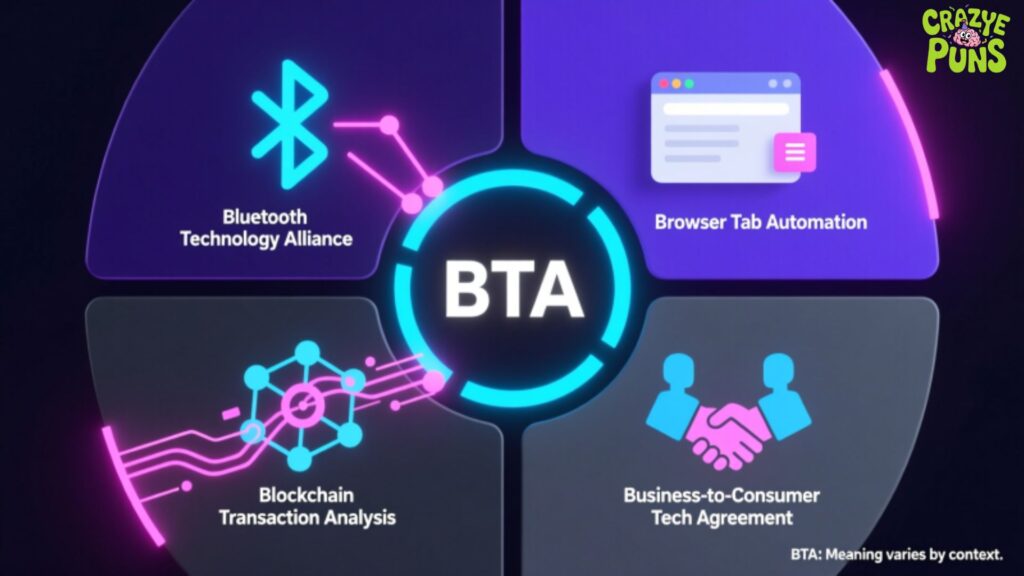
Technology sectors contribute their own interpretations to BTA meaning. Beyond Business Technology Analyst, BTA appears in discussions of “Best Tactical Approach” during project planning, or “Beta Testing Agreement” in software development contexts. Bluetooth Adapter sometimes abbreviates as BTA in technical documentation, adding yet another meaning to this versatile acronym.
Online gaming communities occasionally employ BTA for game-specific terminology. Strategy discussions might reference “Base-to-Air” attacks or “Behind-the-Action” perspectives during gameplay analysis. These specialized uses demonstrate how subcultures develop private languages, with shared acronyms serving as membership markers.
The technical fragmentation of BTA meaning rarely causes confusion because context provides clear signals. A message in a development team Slack channel reading “Complete BTA by Friday” clearly references agreements or testing, not casual second thoughts. This contextual clarity allows the same acronym to serve multiple specialized communities simultaneously.
BTA Meaning in Slang and Casual Conversations
Returning to informal contexts, the casual BTA meaning thrives because it mirrors actual thought processes. Real-time thinking involves consideration and reconsideration, weighing options, and adjusting conclusions. BTA textually represents this mental work, making conversations feel more authentic and less rehearsed.
Young adults use BTA to signal open-mindedness. In an era where strong opinions dominate social media, BTA demonstrates willingness to consider alternatives. It’s an antidote to the aggressive certainty often characterizing online discourse, offering a model for thoughtful, flexible communication.
The casual deployment of BTA also serves identity functions. Using contemporary slang signals generational membership and cultural fluency. When teenagers and young adults pepper conversation with BTA, they’re not just communicating efficiently—they’re performing belonging within their demographic cohort.
Examples of BTA in Sentences
Seeing BTA meaning in action clarifies its versatility:
“The concert tickets are expensive, BTA we’ve been looking forward to this for months.” Here BTA introduces justification for the expense, balancing budget concerns with emotional value.
“I thought the movie was predictable, BTA the cinematography was absolutely stunning.” This usage acknowledges criticism while appreciating artistry, creating nuanced evaluation.
“We could order pizza, BTA we had that yesterday so maybe Thai food?” BTA facilitates decision-making by introducing variety as a consideration without rejecting the initial suggestion outright.
“The weather forecast looks perfect, BTA you know how unpredictable spring can be.” This demonstrates BTA tempering optimism with realistic caution.
“She’s definitely qualified for the position, BTA her availability might be an issue.” Professional contexts use BTA to raise concerns diplomatically.
Each example showcases how BTA creates conversational breathing room, allowing speakers to present complex, sometimes contradictory thoughts without seeming confused or indecisive.
Global and Cultural Use of BTA

Internet culture transcends geography, and BTA meaning has spread across English-speaking communities worldwide. Users from the United States, United Kingdom, Australia, Canada, and beyond employ BTA with remarkable consistency. This global adoption reflects the internet’s role in standardizing certain communication patterns across vast distances.
However, cultural nuances influence how frequently and confidently people deploy BTA. Cultures valuing direct communication might use BTA less often, preferring straightforward statements. Conversely, cultures appreciating subtlety and diplomatic language might embrace BTA enthusiastically as it aligns with existing communication values.
Non-native English speakers learning contemporary slang sometimes find BTA particularly useful. Its structure—a complete phrase compressed into initials—makes it relatively transparent compared to more obscure acronyms. Once someone learns “But Then Again,” remembering BTA becomes straightforward, facilitating adoption across linguistic boundaries.
Why People Use BTA
The persistence of BTA meaning in digital communication reveals underlying psychological and social needs. Humans naturally think in complex, sometimes contradictory ways, and BTA provides vocabulary for this cognitive reality. It validates the experience of holding multiple thoughts simultaneously, reducing pressure to present oversimplified positions.
Efficiency drives adoption too. In fast-paced digital conversations, every saved keystroke matters. BTA delivers complete phrases in three letters, accelerating communication without sacrificing meaning. This efficiency proves especially valuable on mobile devices, where typing remains more cumbersome than desktop keyboards.
Social dynamics also motivate BTA usage. The acronym facilitates disagreement without confrontation, preserving relationships while enabling honest discussion. In group settings where maintaining harmony matters, BTA offers tools for expressing dissent diplomatically. It’s collaborative language for collaborative decision-making.
Tips for Using BTA Correctly
Mastering BTA meaning requires understanding subtle contextual rules. First, ensure your audience recognizes the acronym. While widespread among younger demographics, BTA remains less universal than LOL or OMG. When messaging someone unfamiliar with contemporary slang, spelling out “but then again” might prevent confusion.
Consider tone carefully. BTA works beautifully for genuine reconsideration but can sound passive-aggressive if overused or poorly timed. Constantly second-guessing yourself or others creates frustrating conversation patterns. Reserve BTA for moments when alternative perspectives genuinely add value.
Match BTA to the formality level of your conversation. Casual texting welcomes BTA liberally. Professional emails might require more spelled-out language, particularly when addressing senior colleagues or external contacts. Academic writing typically avoids acronyms entirely unless they’re field-standard terminology.
Vary your language to avoid repetitive patterns. While BTA is useful, constantly deploying the same conversational strategies becomes predictable and potentially annoying. Mix BTA with other transition phrases, using it strategically rather than reflexively.
How to Respond to “BTA”
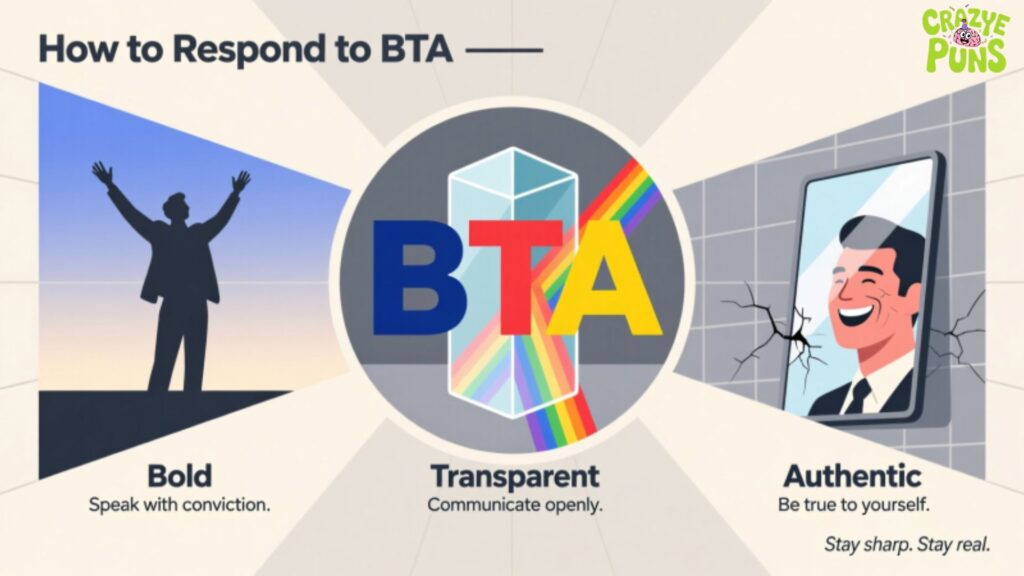
When someone uses BTA in conversation, recognizing the BTA meaning helps you respond appropriately. They’re typically introducing additional perspective, so acknowledge both their initial point and their reconsideration. A response might validate their complexity: “Good point about both sides. What feels more important to you right now?”
Sometimes BTA signals genuine uncertainty requiring collaborative problem-solving. If someone texts “I think we should leave at 6pm, BTA traffic might be terrible,” they’re inviting input. Respond with information or preferences: “Traffic should be okay on weekends, BTA we could leave at 5:30 to be safe.”
Other times BTA precedes gentle disagreement. When this happens, avoid becoming defensive. Their phrasing shows they’re trying to maintain positive tone while expressing honest thoughts. Match their diplomatic approach: “I see what you mean. Here’s why I originally suggested the other option…”
Occasionally people use BTA simply to think aloud. These moments don’t necessarily require extensive response. A simple acknowledgment—”True, lots to consider!”—validates their thought process without derailing the conversation.
BTA Meaning: From Football Fields to TikTok Trends
The journey of BTA meaning from niche acronym to widespread usage illustrates how modern communication evolves. Interestingly, BTA originally had sports significance, particularly in football where it meant “Best Team Available” during draft analysis. This specialized jargon operated independently from the casual “But Then Again” meaning, demonstrating how identical acronyms can serve completely separate communities.
TikTok’s explosive growth introduced BTA to millions of users who might never encounter it otherwise. Content creators using BTA in captions and voiceovers normalized the acronym, making it familiar even to users who don’t actively employ it themselves. The platform’s algorithm, which surfaces content based on engagement rather than following relationships, accelerates slang dissemination across demographic boundaries.
From football fields to TikTok trends, BTA’s versatility ensures its continued relevance. Each community that adopts BTA adapts it slightly, creating micro-variations while maintaining core meaning. This evolutionary process—simultaneous standardization and customization—characterizes successful slang that persists across digital generations.
Understanding BTA meaning ultimately means recognizing language as living, breathing, and constantly adapting. Whether texting friends, analyzing business technology, or discussing trade agreements, these three letters demonstrate communication’s remarkable efficiency and flexibility in our interconnected digital age.
Frequently Asked Questions
What does BTA mean in slang?
BTA Meaning in slang refers to “Better Than Average,” used to describe something that stands out positively but isn’t perfect.
How is BTA used in online chats?
People use BTA Meaning in chats to casually praise something, like a post, performance, or idea that’s above average.
Is BTA a positive or negative term?
BTA Meaning is generally positive, showing approval without exaggeration or hype.
Can BTA be used for people?
Yes, BTA Meaning can describe people, such as skills, looks, or work, implying they’re better than most.
What’s the full form of BTA?
The full form linked to BTA Meaning is “Better Than Average.”
Is BTA common on social media?
Yes, BTA Meaning is often seen on social platforms where short and quick slang terms are popular.
Does BTA mean excellent or perfect?
No, BTA Meaning suggests something is good or impressive, but not flawless.
Can BTA be used in text messages?
Absolutely, BTA Meaning works well in texts because it’s short and easy to understand.
Is BTA formal or informal slang?
BTA Meaning is informal slang and best suited for casual conversations.
Why do people use BTA instead of saying good?
People prefer BTA Meaning because it sounds modern, concise, and adds a cool tone to their message.
Final Thoughts
Understanding BTA Meaning helps you keep up with modern slang without feeling lost in online chats or social media. When someone uses BTA, they’re simply saying something is better than average, not perfect but still impressive. The beauty of BTA Meaning lies in its simplicity and flexibility across conversations. From casual compliments to subtle praise, BTA Meaning fits naturally in everyday language.
As slang continues to evolve, knowing terms like BTA Meaning keeps your communication fresh and relatable. It’s a quick way to express approval without overhyping something. Whether you see it in texts, comments, or captions, BTA Meaning adds a relaxed, confident tone. In short, mastering BTA Meaning helps you stay fluent in today’s digital conversations.

Henry is a witty wordsmith with over 4 years of experience crafting clever puns and humor blogs. Known for his sharp wit and love for playful language, he’s been tickling funny bones across the internet long before joining CrazyEPuns.com.
Now a proud part of the CrazyEPuns team, Henry continues to turn everyday moments into laugh-out-loud wordplay, spreading smiles one pun at a time. When he’s not brainstorming the next viral joke, you’ll find him sipping coffee and chuckling at his own punchlines — because a good pun is worth repeating!
